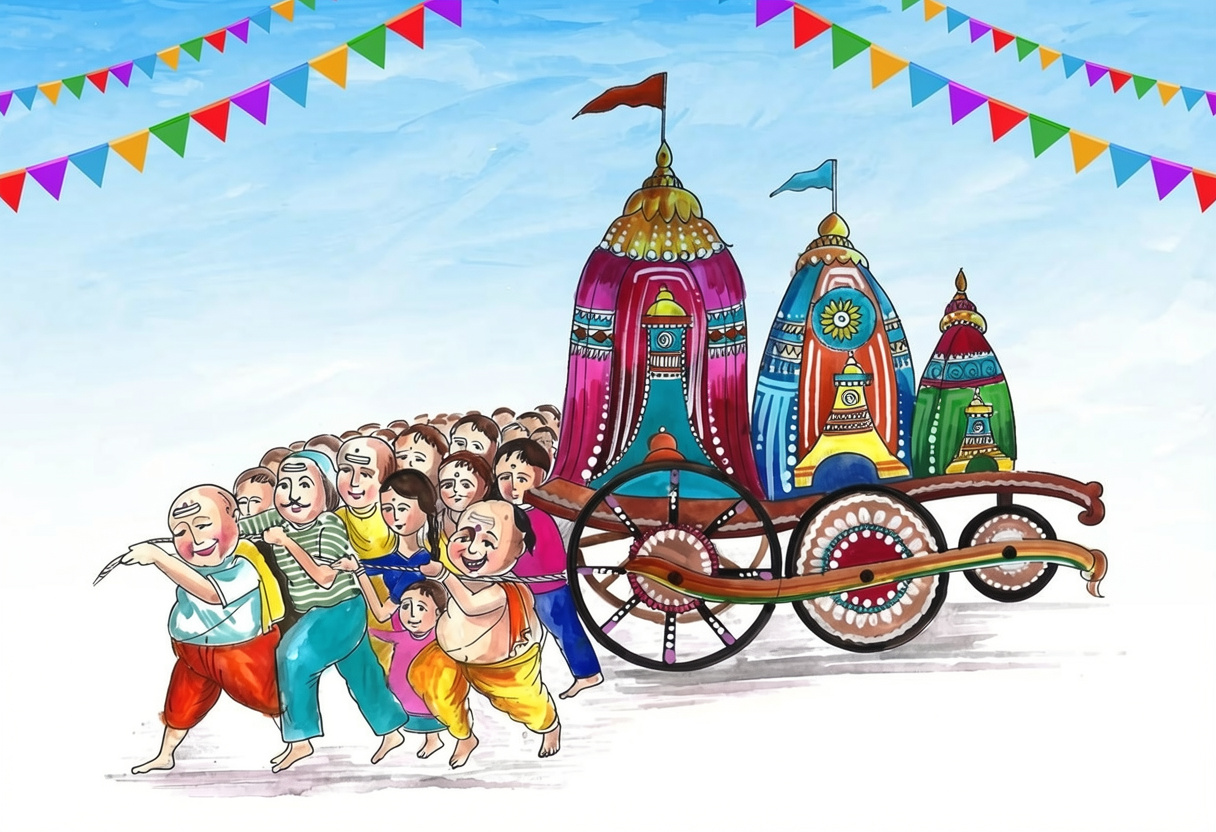
Rath Yatra is a major iconic Hindu festival celebrated every year to commemorate the annual journey of Lord Jagannath, his brother Balabhadra, and sister Subhadra from the Puri temple to the Gundicha Temple. The grand road of Puri gets swept away by lakhs and lakhs of devotees who gather there just to witness and pull the sacred rope of the Rath. Three separate rathas are built for the three siblings' grand journey to their maternal aunt’s house.
This grand excursion signifies a holy family reunion and the loving bond between the siblings. Deities spend nine days at the Gundicha Temple, their aunt’s home, before returning to their native abode, completing the festival cycle.
You will see devotees from around the world travel to Puri, Odisha, to participate in this auspicious festival. It is believed that taking part in this event, or simply witnessing it, purifies one's sins and brings good fortune. The act of pulling the chariots, known as "Ratha," is considered to be a very auspicious deed in human life.
Rath Yatra is a bustling cultural event attracting over millions of people from across the world. It showcases the rich art and cultural heritage of Odisha. The celebration develops a sense of “Unity in Divinity” as individuals from many backgrounds gather together to witness the grand event. In addition to the magnificent ratha yatra processions, the region's cultural diversity is reflected in the celebratory atmosphere created by cultural acts like dance, music, and street performances.
In this blog, we bring you some of the fascinating facts regarding the 900-year-old tradition of Rath Yatra.
8 Fascinating Facts About Rath Yatra
Three New Chariots Get Constructed Every Year
Every year, three new chariots are built completely fresh with no material being reused from past years. These chariots are constructed from a specific type of wood, mostly from Dhausa and Phassi trees. The three chariots are constructed by hereditary carpenters, by putting the material together in a unique technique without the use of a single nail. This master craftsmanship is being passed on from generation to generation without documentation in any manual.
The tallest of the three chariots, Nandighosha, is driven by Lord Jagannath and has sixteen wheels. Lord Balabhadra's chariot, Taladhwaja, has fourteen wheels and is dressed in red and green, symbolizing his position as the older brother. The name of Goddess Subhadra's chariot, Darpadalana, roughly translates to "destroyer of pride" and is the most humble in size. It is crimson and black and has twelve wheels.
The Three Siblings Fall ILL
Following the divine bathing ritual termed “Snana Yatra”, something unusual occurs inside the temple: Lord Jagannath, Lord Balabhadra, and Goddess Subhadra are said to fall ill, making them unavailable for public darshan. The doors remain closed for fifteen days, known as Anasara. During this time, only temple medics, the hereditary daitapatis, visit the deities and take care of them, apply medicinal pastes, and serve them with medicinal concoctions, for quick recovery in the same way as one might nurse a feverish person.
Idols are Reconstructed From Sacred Tree Woods
The three idols of Lord Jagannath, Balbhadra, and Subhadra in the Puri temple are made of sacred wood. The divine carving is done from the wood of the sacred neem tree known as Daru and Brahma. However, the selection of the tree goes through many checks, where specific priests are appointed to embark on their journey, the Banajaga Yatra, to find the sacred tree.
The tree must have divine markings such as a conch (Shankha) or a wheel (Chakra), grow near a water body, and be free of bird nests. This reconstruction is done every 12-19 years, and the old idols are buried with honour by performing proper rituals.
Pahandi Bije
A magnificent, rhythmic procession is conducted by the temple sevaks and devotees when the deities are moved from the temple to their respective chariots. This procession is termed Pahandi Bije. The holy idols are led out by servants who sway them back and forth.
First Lord Sudharshan emerges, then Lord Jagannath, followed by brother Lord Balbhadra and Goddess Subhadra. The temple sevaks drag and push the massive neem-wood idols in a joyful, dancing beat using thick silk ropes just like a rhythmic swinging movement. Witnessing this, not just the deity idols but even the devotees start to swing and dance in ecstasy.
Chhera Pahanra
Chhera Pahanra is a ritual performed during the annual Rath Yatra by the Gajapati king of Puri. The king arrives riding on a silver palanquin and, with a golden broom, cleans the area before the three chariots start their ride. The king serves as the Lord's first servant, or Adya Sevaka. This ritual disrupts the human hierarchy and signifies that everyone is equal before the Lord, be it a king or a common man.
Rath Heads Towards Gundicha Temple
After the Puri King has cleaned up the path, the chariots start their journey to the Gundicha Temple, which is at a three-kilometer distance from the main Puri Temple. As per traditional belief, Lord Jagannath, along with his two siblings, wishes to visit their aunt’s house at the Gundicha Temple after recovering from illness to spend some good time.
However, as per the Skanda Purana, the Gundicha Temple is the home of the wife of King Indradyumna, whose name was Queen Gundicha. King Indradyumna was the builder of the Puri Jagannath Temple, and the Lord considered Queen Gundicha as their aunt.
The three siblings stay there for 9 days and have a relaxing, joyful time together, where their seva and worship are also done in an intimate setting.
Hera Panchami
As Lord Jagannath heads for a nine-day vacation, leaving behind his wife, Goddess Lakshmi, she gets extremely upset and angry. On the fifth day of the Rath Yatra, Goddess Lakshmi loses patience and arrives at the Gundicha Temple in a beautiful palanquin to confront the Lord. In a humorous display of her rage, her servants symbolically ruin a section of Jagannath's chariot, Nandighosha, before she quietly returns to the main temple via Hera Gohiri Sahi.
Niladri Bije (The Return)
This is the final day of Rath Yatra, where Lord Jagannath, along with Balbhadra and Subhadra, returns to his royal temple, the Puri Temple. But, to his surprise, Goddess Lakshmi, who continues to stay upset and angry, shuts the main door of the temple on him. Then a fun argument begins between the servants of Goddess Lakshmi and Lord Jagannath.
Finally, Lord Jagannath accepts his fault of leaving his wife behind for nine long days, and thus he apologises. But Goddess Lakshmi refuses to accept his apology. After trying hard with all the sweet romantic words, Lord Jagannath offered Rossogullas (a soft, sweet, juicy dessert made of cottage cheese), which melted the heart of Goddess Lakshmi. Lord Jagannath was then allowed to enter, and they together enjoyed the Rossogullas.
Wrapping Up
The Jagannath Puri Temple is divine and unique by itself. There are lots of unanswered and scientifically unexplained facts associated with it. This entire place is blessed with divinity. Though throughout the year the temple remains open for devotees to visit, it is during this annual ceremony of Rath Yatra that Lord Jagannath himself, along with his siblings Lord Balbhadra and Goddess Subhadra, comes out to meet his devotees.
The Rath Yatra is an extremely spiritual, cultural, and historical celebration in Hindu culture that brings together lakhs and lakhs of devotees. The tide of devotion in Puri gets so much bigger and bigger every year that it can even overshadow the waves of the Bay of Bengal.